



PhotobucketPhotobucketPhotobucket
PhotobucketPhotobucketPhotobucketPhotobucketPhotobucketPhotobucket

Thursday, February 18, 2021

WHAT DO WE DO WITH THE GRIEF?

There is so much pain in the world today as we navigate more months of social distancing, mask requirements, closed restaurants, bars, and movie theaters, and other community-based establishments. People are anxious, irritable, and downright cranky about having to stay home, stay apart, and stay masked. It's no wonder many of us are experiencing anger management problems. I am dismayed but not surprised that people are venting their anger and frustration by posting their displeasure on Facebook and other social media, as well as protesting with placards in public. When people lose the ability to do whatever they feel is their right, they get angry. Due to social distancing, the anger ends up spilling over in the safe bubble of your family. Anger between family members can be destructive, however, isolating the individuals even more. When did you recently release a blast of anger at a loved one when you didn't mean to? Maybe you've been on the receiving end of one of those yourself. Have you had a crying jag yet? If not, just wait; you will.

It’s hard to stay home and have to face myself. Do you feel this, too? It makes me introspective and self-critical sometimes. I have to look deep within and see how I really think and feel about myself, my neighbors and friends, and the situation the planet is facing on many fronts. But truthfully, the toughest topic is ME. My anger and frustration, my way of “bad othering” people, my thought patterns that are self-demeaning or isolating, my grief at the climate change catastrophe facing us (one friend announced that we can’t fix it, only “prolong the glide”), my sense of helplessness as COVID-19 continues to ravage the world, killing thousands daily, my anxiety about folks who don’t want the vaccine, and then there’s the issue of when I can get my first vaccine shot. I long to do my own grocery shopping or walk into an actual store and purchase a blouse. How do I deal with this morass of emotions? I grieve. I have to or I’ll burst - in anger at others and myself. We all need to grieve the changes that have come about due to the pandemic. We need to take time to feel and process our grief over loved ones and friends lost to COVID-19 and other diseases or accidents. And there’s more to grieve: we must look with clear and honest eyes at the video of George Floyd suffocating under a white policeman’s knee and ask ourselves when we’ve had enough of racism. We must face our grief as we watch the decline of species and plant life, the loss of the ice at the planet’s poles, the death of the oceans, the stubbornness and greed of Big Oil and those who would ignore our planet’s obvious signs of the impending decline and death of all life. I mourn the blindness and greed of the growing number of millionaires and billionaires who would seek to gain more wealth rather than contribute to the equality that we know deep within us is the master plan of the Creator. We are created to love one another as sisters and brothers. There is enough food and water and natural resources for everyone, if only those with control of the earth’s wealth and bounty would share with those who have little or nothing. Humans are so vain, so entitled that we cannot see our neighbor’s needs.This is the largest lump of grief that lodges in my throat each day. I can join groups and attend protests and write to my congress-person and attend Zoom meetings on this topic, but I cannot change the hearts of those who can make the most progress to change the balance of wealth and health and wellbeing for all of us. For this, I grieve; I weep.

During Lent, I find it self-instructive to ask myself hard questions. I look into my eyes in the mirror while I do this. If you’re feeling brave, try these:

Is there anything that I should've let go of a long time ago but am still holding onto?

What can I do to further the equality of all people on this planet we call home?

What am I pretending not to know?

Am I contributing to the world in a positive or negative way? Explain.

Am I proud of the person I am?

What will people say about me at my funeral? 

There are many online grief groups and communities that we can join for an hour or more. They are as close to you as your fingertips on the computer keyboard. Try googling “grief groups” and see what comes up. 

AN HOUR OF GRIEF TENDING

Terry Le Page and I are co-hosting a grief gathering (An Hour of Grief Tending). It meets monthly on the first Saturday from 3:30-4:30 pm PST. The next one is March 6th. Here’s the link: https://www.tickettailor.com/events/opendoorcommunication/476659  Grief can be complex and difficult to unpack in one session. If you attend and it helps you, come again the following month. It’s a recurring event, and each one is a little different from the last.

A grief community that I joined in January was hosted by Bernadette Pleasant and Sara Nics. This presentation recurs about every six weeks. It was effective in helping me unleash my own grief about personal topics. I recommend it. Here’s the link: https://www.eventbrite.com/e/grief-ritual-tickets-133769894355?aff=erelexpmlt

If you doubt the effectiveness of grieving in a community or group, read this article from Eden magazine to help you better understand the dynamics involved in grieving in this way.  https://theedenmagazine.com/the-healing-power-of-the-grief-ritual/

Perhaps you decide that joining a Zoom meeting to grieve isn’t for you; if so, then maybe you can spend some time writing or journaling about the things in your life that you grieve. Just writing it down as I did has helped me release and process some of my grief.

May peace reside within you and around you. 

With hope and compassion,

Lynne


Thursday, September 20, 2018

Falling in Love with God: The Life of Prayer

Someone once said that being in the presence of God was like “living each moment as if all Eternity converged upon it.” How do we live like this? Can we live with our wicks turned up that high without burning out? Yet Eternity is converging upon this very moment. What is happening now – this reflection, our struggles to understand, the reading of this paragraph – will never happen again. Engagement with others and with God takes place at Eternity’s converging point.

Seventeenth-century Carmelite Brother Lawrence speaks of the “practice of the presence of God.” Anglican Pastor Jeremy Taylor talks about “holy living.” Albert Schweitzer called it a “reverence for life.” Douglas Steer speaks about “being present where you are.” Jesuit philosopher Teilhard de Chardin calls it the “divine milieu.” How do we wake up to the presence of the kingdom all around and within us?

Recall the story of Mary and Martha in Luke 10:38-42. Clearly Jesus’ concern here was the convergence of Eternity in the present moment. Jesus was not criticizing Martha for her effort to be a good hostess, nor did he mean to elevate the contemplative above the active life. Rather, he zeroed in on Martha’s busyness and anxiety, which were causing her to miss what Jean-Pierre de Caussade called “the sacrament of the present moment.”

Oblivious to all the work her workaholic sister had to do, Luke says, “she was sitting at the Lord’s feet and listening to what he was saying.” You can feel Martha’s temperature rising as she puttered around preparing food, setting the table, doing “a lot of work” while Mary sat cozy on the floor at Jesus’ feet. Martha finally speaks out in anger about the situation, and implores Jesus to make Mary get up off the floor and help her.

In responding to Martha, Jesus did not put down work. What he criticized instead were those characteristics of busyness and anxiety, so pervasive in our own society, which dampen prayerful attentiveness to the convergence of Eternity upon the moment. Jesus gently admonishes her: “You worry and are upset about a lot of things…” Poor Martha. A glimpse of Eternity slipped past her unnoticed, while Mary’s “laziness,” if we want to call it that, let her partake of the sacrament, allowed her to soak up grace.

How can we live like Mary, with a desire to live every moment attentively and responsively? Our Martha-like compulsive driven-ness and sense of duty keep us with shuttered ears and eyes to the glory of God all around us. How often do we miss the “sacrament of the present moment?”

We begin to live like Mary by living attentively. We begin by practicing the presence of God. And we begin by making our life a life of prayer. None has offered a clearer and simpler solution than the simple monk, Brother Lawrence. The longer I have studied The Practice of the Presence of God, the more convinced I am that this simple and good man just fell head over heels in love with God and let that transfuse and transform everything he was doing. “I turn my little omelet in the pan for the love of God,” he explained. People try all kinds of methods to learn how to love God, but is it not better, he asks, “to do everything for the love of God, to make use of all the tasks one’s lot in life demands to show God that love, and to maintain God’s presence within by the communion of our heart with God’s?”

How do we fall in love with God? Is that something only a naïve, uneducated person like Brother Lawrence could do? Can we who have benefited from education and who live such full and busy lives love God enough to live each moment as if all Eternity converged upon it? Brother Lawrence thought everyone could do so. His formula was simple: “We must know before we love, and to know God we must often think of God. And when we love God, we shall think of him all the more, for our heart is where our treasure is.

Author Thomas Kelly invites us to be attentive to God’s presence, and then to be prayerful in all that we do. Live in utter openness to God. Quietly, behind the scenes, keep up a silent prayer, “Open Thou my life. Guide my thoughts. Thy will, not mine, be done.” As you chat with friends, pray every moment this internal continuous prayer of submission.  Kelly’s suggestions for this silent prayer: “Be Thou my will,” or “I open all before Thee,” or “My God, my God, my Holy One, my Love.”

To live a life of prayer is to begin the surrender of ourselves to his divine will. Prayer begins when we open the shutters of our heart and send forth the dove of desire for God. Amen.

Tuesday, July 24, 2018


Writing Love Letters to God

A title such this one is bound to get your attention. “Love letters to God!” you might say, “What's that?” Well, a love letter is what I think of whenever I sit down and take the time to journal. It’s really a love letter to God. After all, who else loves me so much that they would be glad to read my funny scribbles and musings about my life? The little doodles that I fill up the margins with: drawings of clouds and trees, names, crosses and interlinking circles? Who else would care that much? Only God, that’s what I think.

What’s a journal anyways? It can be whatever you imagine it to be, that’s what. There are so many types of journals that I could fill this page with descriptions, but let’s not. Rather, let’s look at a very simple type of journal, and a more involved one, too. Maybe after reading about them, you might be tempted (nudged by the Holy Spirit, perhaps?) to try this way of writing.

The easiest is the daily journal, which is a record of the day’s happenings as well as the effect those happenings had on one’s life. This form is most consistent and is usually dated. Its impact will be noticed at the reading of the entries after a 4-6 week period. Most folks think of this as a diary, but it’s different in that you also write how you are affected by what happens in your life on a daily basis.

Another type of journaling is done in response to scripture. Here are the basic steps to prepare yourself: Pray that this time might be an opening to God’s spirit. Find the day’s selected scripture passage. Read the passage slowly. Try to visualize its images. Jot down any ideas, questions, key phrases that come to you as you read. Begin writing on a blank page. Writing your deepest responses to God’s word is what counts here. Then ask yourself: what might God be saying specifically to me? Let yourself sink deeply into your core as you listen, listen, listen to what God is speaking within you. Write down everything that comes to you, even if you think it’s strange or disturbing. Ask God why He is saying these things to you. What might God be inviting you to do? Is there a challenge from God here? Do you feel a shift inside? When you feel a sense of closure to your writing, take time to thank God for these words of scripture and God’s message to you personally.

“So, tell me again,” you say, “Why do you call journaling a love letter?” Well, think about writing the most secret, the most important, the most cherished things, and the deepest longings of your heart down on paper. Who would you trust with those things? Who COULD you trust with those things? Who else would continue to accept and love you unconditionally after reading all the utter nonsense and delightfulness that exists in the depths of your soul? Yep, you got it right: GOD. God is the one Being who will always love you no matter what devilment you hatch, no matter how crummy you feel (and take it out on others), no matter what your hair looks like in the morning, and no matter how many times you run away from Him. God will always take you back, no matter how prodigal you become. Trust in that fact.

So, take the time this week to write a little love letter to God. And I will, too.

On the journey with you, Lynne

Monday, March 12, 2018

A Daily Review of Life

Looking for something prayerful to do during Lent this year? Try this: a daily review of life. This is a way to examine our thoughts, feelings, and experiences in terms of how God is present and how we are responding. It fosters an awareness of God’s presence and call in our daily lives. There are many different forms of this examination of the self; the one presented here reads as a conversation with God. You might start a daily personal journal using this model. Start today, keep at it, and over time you will see a deepening of your relationship with the Lord. God is waiting for you to recognize that he is everywhere in your life. Seek him now in this simple review of your daily life.

Start with a prayer like this: God, my Creator and Redeemer, I am totally dependent on you. Everything is a gift from you. I give you thanks and praise for the gifts of this day. Give me also an increased awareness of how you are guiding and shaping my life, and of the obstacles I put in your way. Be near me now and open my eyes as I reflect on these questions. Amen.

* Your presence in the events of today:

__________________________________________________________________

* Your presence in the feelings I experienced today:

__________________________________________________________________

* Your call to me:

__________________________________________________________________

*My response to you:

__________________________________________________________________

God, I ask for your loving forgiveness and healing. The particular event of this day that I most want healed is:

__________________________________________________________________

The particular gift or grace that I most need is:

__________________________________________________________________

I entrust myself to your care and place my life in your strong and faithful hands. AMEN.

Monday, February 16, 2015

LOVE IS


The month of February always brings to my mind the images associated with love; romantic love, friendship love, community love, family love, and the love of God. If you’re like me, you have strong associations and vivid pictures in your mind concerning love: red roses, couples embracing,  walks on a winter beach holding hands, and relaxing together by a crackling fire. That’s the romantic love, the Valentine’s Day love, the human love we enjoy with our spouse or special someone. Friendship love, which is that special glue that binds two friends close in sharing joys and woes, celebrations and memorials, giddy fun and everyday hum-drum, is a love I hope we all share with several close friends.
But the love that comes from God is completely different. So completely Other that we really have no word in our languages that can even come close to describing the Love that holds everything in existence, without which all things in creation would fly apart into chaos. In fact, the word love and the practice of human love is flat in comparison.  Love by God for human beings (philanthropia) is lauded in Psalm 52:1: "The steadfast love of God endures all the day"; Psalm 52:8: "I trust in the steadfast love of God forever and ever"; Romans 8:39: "Nor height nor depth, nor anything else in all creation, will be able to separate us from the love of God"; 2 Corinthians 13:14: "The grace of the Lord Jesus Christ and the love of God and the fellowship of the Holy Spirit be with you all"; 1 John 4:9: "In this the love of God was made manifest among us, that God sent his only Son into the world, so that we might live through him.” And so on. There are many instances of God’s love in Scripture. All of them are astounding and amazing when looked at through the lens of our human sinfulness and fallen nature. The question then arises within us:  “How could I still be loved so much, even after I __________?” (Fill in the blank with your current sin.)
Just the fact that we ask that question shows us how much we don’t know about God’s nature. In fact, I venture that we don’t know God because we don’t know how to think that big; our human consciousness simply isn’t capable of holding the meaning of that much love. But as much as we try to fit God into a box of our own making, thereby controlling God so she/he doesn’t get too big, too scary, too unmanageable, we simply cannot squeeze God into whatever shape we want God to be. God always escapes and eludes our grasping fingertips, blazing away into the starry sky to shine down upon our upturned faces like the Nativity star, leading us and the wise men ever onward into unfamiliar territory. And we, like those wise men (“wisdom people”) who left the safe borders of their own countries and traveled into parts unknown, have to find the courage to make the first, faltering steps toward the great Other that we have come to call “God.”
Remember our fill-the-blank question? Maybe we’re asking the wrong question. Maybe - instead of asking how God can still love us after all the awful things we do and say to each other every day, the questions we should be asking are these:

How am I called to be in the world, knowing that God loves me 
unconditionally?
What is the most loving and caring way I can live, knowing that God 
loves me this much?
Where can I give back to someone or something, knowing of God’s
great Love for me?

I invite you to recognize and celebrate God’s amazing Love for you by living one of these questions this month. And - I’d love it if you would share with me what happens when you do.


Thursday, May 29, 2014


The Prayer of Adoration

Something wonderful and holy happened to me while I was in Hawaii for the annual synod assembly gathering that our synod, Pacifica, holds each year to allow pastors and other rostered leaders of the church to some together for conversation, collegiality, fellowship, and the business of the Lutheran church, which includes decision-making and resolutions, and many other church-wide concerns. Yes, the gathering of church leaders and delegates from the two states that comprise our synod and the business that we were about was certainly conducted with prayer before, during and after - there was holiness in that. And yes, the people chosen to attend took their task very seriously, and gave the business at hand their full attention, trusting in God to guide their hearts and decisions. This, too, was holiness in action, and it was wondrous to witness. But something unexpected happened, too. Something that took me by surprise, took my breath away, took me into a unexpected and very holy experience of God.
 
As you know, I love prayer. I love to pray, to read about prayer, teach prayer forms, practice and experiment with prayer. Prayer is holy! Talking to God is holy. Listening to God is holy. And experiencing God in nature is holy, too.
 
During the synod assembly on Oahu, all the attendees were offered different excursions for Thursday afternoon. Some people went to visit the plantation villages, others to Hanauma Bay to learn about the local marine life, some went to the Arizona Memorial or a Buddhist temple. My group went to climb a muddy, rocky, sometimes steep trail up to Manoa Falls, which is about a one mile hike each way through lush rainforest. Jurassic Park IV was busy filming on location, so we almost didn’t get to hike, but finally got through. Our group consisted of people of different shapes and sizes and degrees of fitness, so we hiked separately or in twos, depending upon one’s ability and speed. I ended up alone on the trail much of the time, which suited me well. A fine mist rained down the entire time, and the local bird life was talkative and exotic. There are wild pigs in the area (which are hunted with dogs on Wednesdays and Saturdays), but I saw none on my hike, luckily. To the right of the trail was the river, whose source was the waterfall, and this chuckled and coursed busily over boulders, shaded by giant ferns and vines twisting crazily up tree trunks, huge leaves four feet across billowing in the humidity. Fallen trees covered with moss and ferns lay across the trail - but above my head - supported that way by a mound of boulders on the farther side.
 
As I walked and climbed the shady trail, my senses drank in the beauty of that wild place: the cries of tropical birds, the greeny shine of geckos on tree trunks, the song of the river and rocks. Attaining the goal of the waterfall, I sat breathless on a rock by the pool and let the mist from the falls wash my face, arms, and legs. Others sat as I did, their hair wearing a halo of water droplets, their eyes fixed on the downward sweep of water, 100 ft. high. Alone on the way down the mountainside, the glorious mystery of God in creation worked its way into my heart, and tears mixed with rain on my face. Pausing by the river’s edge in a clump of bamboo while I gazed into a deep pool, I prayed the prayer of adoration.  
The prayer of adoration is not a special form of prayer, for all true prayer is saturated with adoration. It is the air in which the prayer breathes, the sea in which the prayer swims. In another sense, however, it is distinct from other kinds of prayer, for in adoration we enter the rarefied air of selfless devotion. We ask for nothing but to cherish God. We seek nothing but God’s exaltation. We see clearly God’s goodness. In the prayer of adoration, we love God for Godself, for God’s very being, for God’s radiant joy. When we are filled with absolute unselfish love for God and commune with God in those moments, our response is the most direct of all; this is the prayer of adoration. Adoration is the spontaneous yearning of the heart to worship, honor, magnify, and bless God.

How long I stood there adoring God, I cannot say. But something, maybe a mosquito buzzing in my ear, shook me alert to my surroundings again, and I bowed solemnly to the river, thanking God for the gift of this prayer. This is the finest, most holy time I experienced while on Hawaii at our synod assembly. It’s not something I will forget soon, if ever. Thank you, Risen Lord, for the reminder that you are at the center of all that exists, and that in your creation, I find your fingerprints everywhere and feel your breath upon my face. Amen.


Wednesday, April 23, 2014

Advent Labyrinth Walk

If you've never walked a labyrinth before, it's an amazing experience and one that you might look into if you are committed to your spiritual journey. For directions on how to walk a labyrinth, look under the tab on the home page and find "Labyrinth Walks." I'll try to keep upcoming labyrinth walk dates posted for you. In the meantime, enjoy these pictures of the labyrinth walk and prayer stations that I hosted during Advent 2013 at Our Redeemer Lutheran Church, Garden Grove, California.

 Prayer station: hand prayers

 Prayer station: Pondering (light candles for what you desire)

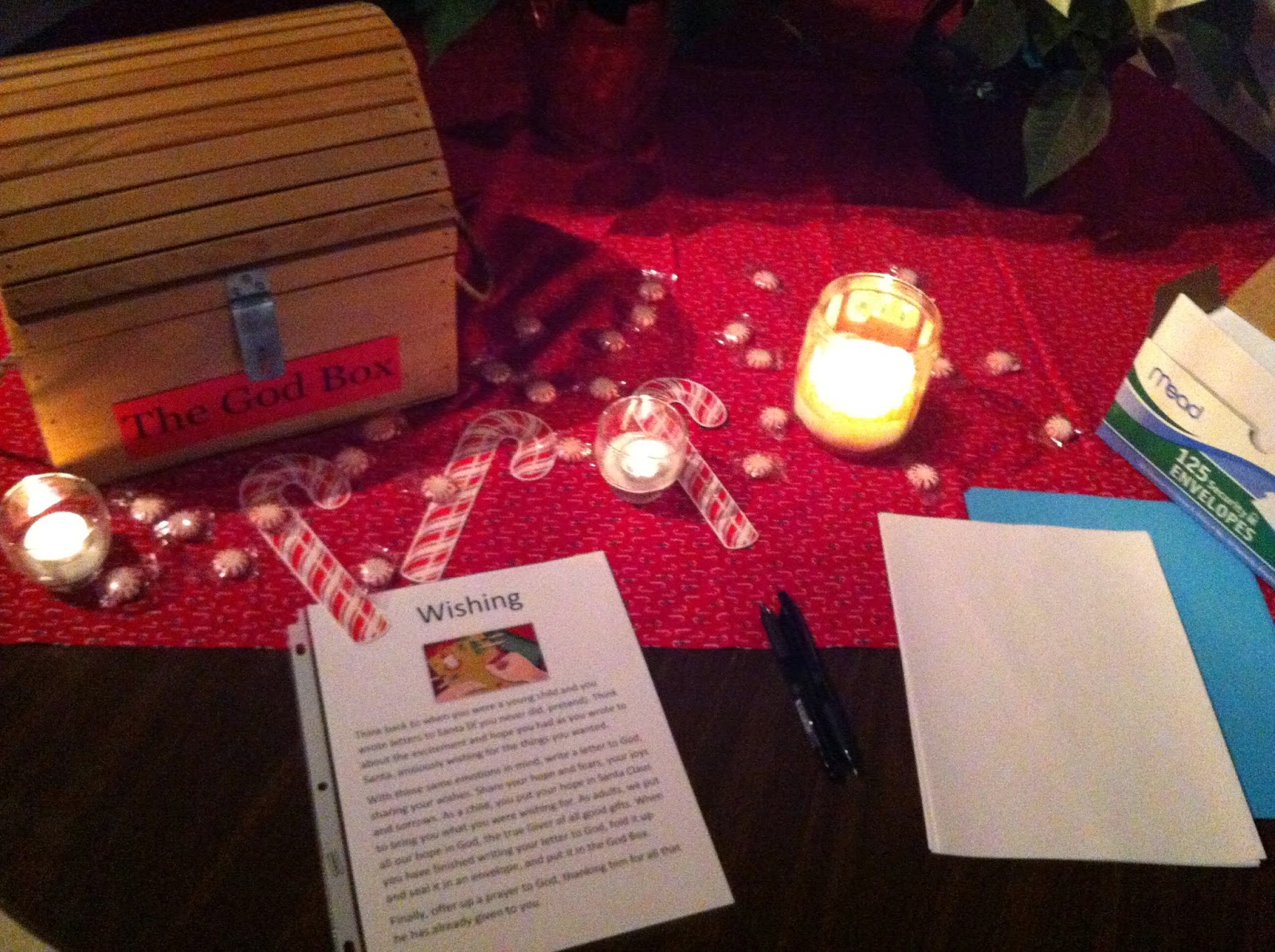
Prayer station: Wishing (writing to God)

The holy family at the labyrinth entrance.

Prayer station: Paper chain prayers

 A diffused halo around the center of the labyrinth.

Prayer station: Listing & releasing what takes our focus off Christ.


Lent Labyrinth Walks

The labyrinth center with a crucifix as focus point.

I just hosted a labyrinth walk with six new prayers stations during Holy Week in April 2014. 

Here are a few photos from some Lent labyrinth walks that have taken place at Our Redeemer Lutheran Church in Garden Grove, California. 
Prayer station: What Binds You?
Prayer station with nails.
Prayer station: Carry Your Cross
Prayer station: The Holiness of God


Prayer station: Christ's Crown of Thorns


Friday, February 22, 2013

Reflections for Lent

Experiencing the 13th Psalm in a New Way 

I was affected rather strongly by something I read recently. I've been reading through the Bible with a group of about twenty-five friends, and a particular psalm, Psalm 13, verses 5 and 6, have stayed with me, especially. Here they are:

"But I trusted in your steadfast love; my heart shall rejoice in your salvation. I will sing to the Lord, because he has dealt bountifully with me."

Steadfast love. These two words jumped out at me in the verses, and I’ll explain why. First of all, my Lutheran (ELCA)Study Bible has a sideline of notes for the reader, and I always read them because there’s much to learn there. This is what I found: “The concept that most briefly and clearly sums up God’s character is ‘steadfast love,’ based on the Hebrew term chesed. This term describes the character of one who keeps promises, proves faithful, establishes justice, and defends the vulnerable” (pg. 860). Chesed is also commonly translated as “lovingkindness.” Chesed is central to Jewish ethics and theology, and it is considered to be a primary virtue in Jewish thinking. In fact, chesed as a virtue is so foundational that it is believed to contribute to the “repairing of the world” (Wikipedia). Steadfast love and lovingkindness; this is God’s promise for all of Creation, and we need to keep pinching ourselves as a reminder that this promise is for us – that we are the recipients of this Great Love, and that we can “repair the world” when we show chesed to one another and to those outside of our church family, too. I like that thought: that we can contribute to the ”repairing of the world.” In what ways does that phrase resonate within you? Repairing the world. Definitely not something we do by ourselves, is it? With the Holy Spirit's power and guiding force within us and fueled by God’s steadfast love, we can reach out with care and kindness to all those we encounter in our workplaces, neighborhoods, and church community, making a difference by being the loving hands and face of Christ in the world. Keep this close to your heart as a Lenten practice, perhaps. And I'll join you.

In Lenten reflection with you,
Lynne

Tuesday, July 10, 2012

Thoughts after reading Barbara Brown Taylor      

      I've been reading quite a bit of author Barbara Brown Taylor lately, and just finished Leaving Church: A Memoir of Faith. After being a Episcopal priest for twenty years, Taylor leaves her position as rector of a rural church in Georgia to accept a chair in the religion department at Piedmont College. Her book details the journey she undertakes from seminary to the present using language that stirs the heart and enables one to feel within oneself her painful, personal self-discoveries. As she finds herself drowning in "compassionate fatigue" as a priest, she realizes that to leave the position she loves is the only way to save her life. Taylor allows us to see into her soul as she pours out upon the page all of her anguish, uncertainty, and struggle as she begins the transition from the congregational setting to the university campus.
      As a person in ministry, this book resonated with me deeply, for I can see all too clearly how we ministers can slip into feeling needed and indispensable in the church setting. We find ourselves as being the one who's in charge, tossing life preservers to sinners with authority, and standing in front of people each week who listen to our every word. It can be heady stuff. What's troublesome is when we believe that we are in control and no one else can measure up, that everything depends on us, that our way is the only way to "do church."
      I remember in seminary during my Pastoral Theology course that we read Greg Ogden's Unfinished Business: Returning the Ministry to the People of God (Zondervan, 2003), and how I was struck by how we function in church with an institutional mindset, which is an extremely counterproductive ministry model. Ministry should be about equipping the people; after all, this was the vision Jesus had for his disciples when he sent them out in small groups to preach, teach and heal. Servant leadership is the model that Ogden proposes, and we would do well to explore this model if it isn't in place in our churches today. It's certainly a healthier model than the traditional pyramid; the top-down style.
     It's all well and good to say that one model is better than another, but I remind myself that receiving a call from God to enter into formal ministry can wreck all kinds of havoc in one's heart and life, and all kinds of feelings of superiority can easily arise within during the training, seminary education, interviews, and candidacy processes; so much so that by the end of our preparations for ministry, we somehow have puffed ourselves up to such an extent that we feel entitled to be the one giving orders and in charge of saving sinners. How vain we are! Hopefully, new ministers are placed into loving (and forgiving!) congregations that gently knock these feelings of superiority out of them with the everyday trials of a minister's life: visits to the homebound, budget meetings about the leaking sanctuary roof, homeless people asking for rent money, and parishoners who don't like your sermon delivery style or the new banner behind the altar. But sometimes it just takes years of parish life, while God whittles and pares away at you all the while, and you find yourself somewhat lighter and leaner in soul, your egotist presumptions left somewhere behind you along the path. There comes a time when you no longer feel strong reactions kick you in the gut when someone is less than polite, when the battles you thought worthwhile ten years ago are now not worth a moment's consideration, when more often than not the first thought in your head is not, "How dare they," but "What would Jesus do in this situation?"
      So this is the journey, the spiritual journey that we all share, whether we are aware that we are on it or not. Life whittles away at us, paring us down to what matters most, and if you're a Christian, then it's Jesus Christ, and how to live your life as closely aligned to his as you can possibly get it. Hopefully, the more the ego gets rubbed away, the better to see the light of Christ shining from within. That's the hope and the prayer, anyway. May Christ walk with you on your journey of faith, now and always!

      I'll be picking up another of Barbara Brown Taylor's books soon, I know. I've already read When God Is Silent, and An Altar in the World: A Geography of Faith, and I highly recommend them both to you. To find out more about Taylor, visit her website at www.barbarabrowntaylor.com. You can find her books on Amazon.com and at many book stores.

Wednesday, June 6, 2012

Recently, a small group that I'm a part of took some time to practice lectio divina (sacred reading) using devotional materials instead of scripture. The following poem by John Masefield was my contribution to the gathering. It has stirred me deeply for years, and each time I ruminate on it, fresh revelations bubble up. I share it with you here. Take time after reading it at least three times through to find what images or words attract you. Stay with the words and images. Ask God what He's trying to tell you through them. Allow yourself to sink into your heart while you ponder if there is an invitation or challenge for you here. Whatever emotion or feelings arise, honor them. Don't rush the process; step into kairos time with the Holy One. Take time to thank God for whatever happened for you during the practice, then silently rest in His presence without thinking. Just soak in the message God gave you. Try it now.

O Christ who holds the open gate,
O Christ who drives the furrow straight,
O Christ, the plough, O Christ, the laughter
Of holy white birds flying after,
Lo, all my heart’s field red and torn,
And Thou wilt bring the young green corn,
The young green corn divinely springing,
The young green corn forever singing;
And when the field is fresh and fair
Thy blessed feet shall glitter there,
And we will walk the weeded field,
And tell the golden harvest’s yield,
The corn that makes the holy bread
By which the soul of man is fed,
The holy bread, the food unpriced,
Thy everlasting mercy, Christ.
   
John Masefield (1878-1967)
A native of Herefordshire, England, he published three collections of ballads in 1902, 1903, and 1910; and The Everlasting Mercy, a conversion epic, from which the following lines are taken, in 1911. Masefield was appointed Poet Laureate in 1930.

If you're not familiar with lectio divina, refer to the blog post beneath this one where you'll find more information on the Christian practice including step-by-step instructions. Blessings on your journey!

Wednesday, May 2, 2012

Lectio Divina - Reading Scripture with Deeper Eyes:  I've been revisiting an old and favorite prayer practice lately, that of lectio divina. If you're not familiar with it, lectio divina means "sacred reading." A new small group that I'm a part of is studying lectio divina for a few weeks, so I have submerged myself willingly into God's Word in the pages of the Holy Bible in order to discern what He/She is saying to me personally. Yes, personally! God will speak to you through the pages of scripture, for the Bible is not just words on the page, but a living communication from the Divine. Don't believe it? Try it out for yourself. Read about the four stages of the prayer, then follow the steps at the bottom.

Basically, there are four steps to lectio divina: lectio, meditatio, contemplatio and oratio.  Some people do the first three steps and omit the last.  Do as the Spirit guides you.  When doing lectio divina, the four steps flow naturally into one another, and not always in the order which is presented here.  The Holy Spirit is responsible for and leads you through the steps of lectio divina.

Lectio – reading & listening
To begin, you read from Holy Scripture, picking a passage, which speaks to you in a personal way. Not ordinary reading, like a magazine or book; but, taking in the Word and pondering it in your heart, memorizing it while gently repeating it to yourself, reading and listening at the same time, with your whole being.  Read slowly with great attentiveness to each word and phrase.
 

Meditatio – meditation

In Meditatio, you reflect on the Word of God by memorizing a brief phrase or passage from the longer text that was read, some part of it that spoke to you directly.  Think of ruminating, or “chewing the cud” of this phrase; taking it into yourself, deeply.  Once you have it memorized, repeat it again and again, and then enter into the picture that you create in your mind.  Let yourself be in the crowd as Jesus gives His Sermon on the Mount, if that is your passage.  Hear His words directed at you, when He says, “Blessed are you.” (Matt 5:11)  Feel what that experience does to you.  Take the text and use it to enter into relationship with Him, and learn.  Let His Words teach you directly, now, in your heart.

Contemplatio – contemplation
 At this point, you will find words and images drying up, as you silently contemplate God.  This part of the process happens to you; you cannot make it happen, and you have no control over it.  Let yourself simply rest in God’s presence now, because you find that no thoughts or words are adequate to describe what you are feeling.  When this happens, relax and flow with it.  Rest in God and be at peace.  Nothing is required of you at this point; just accept the loving embrace of the One Who loves you as His child. 

Oratio – spontaneous prayer
 This is the spontaneous prayer that arises from you as you meditate on the Word of God.  As you are touched by the text’s deeper meaning for you, your heart opens in response to your new understanding, and a rush of feeling overflows in an outpouring of verbal prayer, tears or wordless praise.

Here are the steps for you to follow:


 1.             Choose a short passage from Scripture.  Keep the passage short; just a sentence or two, and no more than a paragraph. (Suggestions are below.)

2.             Read that passage slowly and meditatively, over and over again.  Ruminate on this passage until it is committed to memory.

3.             Visualize the passage.  Feel your way into the passage.  Put yourself in the action, and let yourself experience the realities that the passage points to.  Really become fully involved in what is happening as you listen to and interact with Jesus.

4.             After a time, your visualization will come to an end of its own accord.  When this happens, just rest in contemplation for a while.  Simply sit in stillness and silence and be open to the loving Presence of God.  Relax and just “be.”

5.             When your contemplation comes to an end, offer up to God the spontaneous prayer from your heart, and your gratitude for this gift.  Then you may end your period of meditation by gently bringing your awareness back to yourself and opening your eyes.

  Suggested scripture passages:

Matthew 13:44     “The reign of God is like a buried treasure which a man found in a field.  He hid it again, and rejoicing at his find went and sold all he had and bought that field.”

Jeremiah 1:5        “Before I formed you in the womb, I knew you.”

Matthew 28:20     “Know that I am with you until the end of time.”

 
Micah 6:8             “He has told you, O mortal, what is good; and what does the Lord require of you but to do justice, and to love kindness, and to walk humbly with your God?”

Romans 8:38-39   “For I am convinced that neither death nor life, nor angels... nor things present, nor things to come… nor anything else in all creation, will be able to separate us from the love of God in Jesus Christ.”